Riding bikes without cycling

13 Apr 2026 | 172 words | canada cycling messengers labor travel

Walking around downtown Toronto after an early dinner tonight, something odd caught my eye. It seemed that most people riding bicycles around me were not, in fact, cyclists. At least around dinnertime, the vast majority of people riding bikes here are food delivery workers. And if you watch closely, almost none of them are actually cycling; instead, they solely rely on the electrical motors of their e-bikes. To the trained eye of a former bike messenger1, this looks very odd.

The fact that most food delivery workers on bikes do not cycle is clearly legible when looking at the chains of their bikes: Many of them have chains so rusty that they are stuck in odd angles, others have chains permanently stuck between the frame and the cogs or zip-tied to their chain stays, and a surprising amount of them simply lack chains at all.

Toronto delivery bikes with(out) chains

  1. A long time bike messenger who came to Toronto once for an indoor bike race thrown by the city’s legendary bike messenger community of the late 1990s ↩︎

When the train gods are kind to you

08 Jan 2026 | 371 words | europe travel fragility snow winter railways

Earlier this week — in an impressive demonstration of the fragility of our efficacy-optimized economy — a few centimeters of snow combined with temperatures a few centigrades below zero let the Netherlands descend into utter chaos. The railway system collapsed, the national airline stranded thousands (leading to predictable letters to the editor that it be stripped of the K in its name that denotes royalty), and anyone was advised to stay at home to avoid bodily harm.

In the midst of this, I had planned to travel to Warsaw by train. My first attempt — I had decided to take one connection earlier to allow some additional buffer time for the connection in Berlin — failed because the train never showed up. When I went back for my originally scheduled connection, it turned out that the service to Berlin was the only train still running; every other train had been cancelled due to an ICT failure in the systems of the national railways. The ICEs, however, are run by the German Railways.

All trains are cancelled except ICE145 to Berlin HBF

Somewhat miraculously, the train departed almost on time — we had to wait for some missing staff. Sure, there was no service from the restaurant car — “Unfortunately, the Bordbistro is closed because the staff did not come because of the weather conditions” — and the train was a bit overcrowded with people using it to get to other parts of the Netherlands, but we made it out of the chaos-stricken country only 20 minutes behind schedule.

After the border, a new Bordbistro crew materialized and started serving lunch and coffee. We made it to Berlin with 15 minutes of delay, which allowed me to have a chat over coffee with Berlin-based colleagues before boarding the 1700 PKP intercity service onwards to Warsaw, which after a rewarding meal in the restaurant car — the WARS restaurant cars remain the best in Europe — and an otherwise uneventful trip delivered us right on time at 2300h, into Warszawa Centralna.

WARSZAWA CENTRALNA

Somebody should tell the angry letter-writing KLM customer that there is a train going from Berlin to Amsterdam every two hours every day. It beats flying even when the weather is nice.

Machines vs Elections

08 Aug 2023 | 500 words | artificial intelligence democracy elections

So over the wekend we learned that Sam Altman is apparently nervous about the impact of AI on democratic elections:

i am nervous about the impact AI is going to have on future elections (at least until everyone gets used to it). personalized 1:1 persuasion, combined with high-quality generated media, is going to be a powerful force. (@sama on x, 04-08-2023)1

And that even though he is the CEO of the company that has arguably done more than anyone else to get generative ML tools into the hands of the public, he cannot come up with anything better than “raising awareness”:

although not a complete solution, raising awareness of it is better than nothing. we are curious to hear ideas, and will have some events soon to discuss more. (@sama on x, 04-08-2023)

It seems that Altmans “concern” is something that has already had its impact on OpenAIs public policy narrative. A few hours after Altman’s tweet, Open AI’s new European head op policy and partnerships had translated this into a call to action:

Who are the best thinkers/builders at the intersection of generative AI and elections in Europe? Ideas welcome! (@sGianella on x, 04-08-2023)

Now, there are plenty of reasons to suspect that Altman’s “nervousness” is nothing more than self-serving criti-hype (see here for such an interpretation), but in this case it is worth dwelling a bit on the particular connection being made between AI and elections (especially since both the US and Europe have upcoming elections).

There are indeed reasons to be concerned about the impact of generative ML models on elections and other democratic processes2, but it is beyond absurd that such concerns are being articulated by Open AI and its representatives:

The way in which Open AI introduces its models into the public sphere stands in stark contrast to the very norms of openness, transparency, and equality on which democratic elections are based. Instead of these values, Open AI deliberately hides how its models are trained, making it impossible for researchers, policymakers, and the general public to understand “the impact AI is going to have on future elections.”

If Sam Altman and his surrogates are truly interested in limiting any undue interference of the technology they are peddling to the public with upcoming elections, then they should apply the same level of transparency to their publicly available models. Until that happens, we should keep ML systems as far away from the electoral process as possible.


  1. Given the unstable nature of the platform formerly known as twitter i have made a screenshot of the posts quoted in this conversation available here↩︎

  2. Although the impact is probably overstated, the underlying problem is not so much “AI” but rather disinformation that may or may not be aided by “AI” systems. As Sayash Kapoor & Arvind Narayanan have convincingly argued the real bottleneck for disinformation campaigns is not its generation but rather its distribution and as a result it is at the distribution level where this problem should be adressed. ↩︎

Live from Luxembourg

23 Apr 2022 | 658 words | copyright democracy justice europe

In November 2020 - as the second wave of covid infections crested over Europe - I drove 418 kilometres through the night to report on the hearing in Case C-401/19 at the Court of Justice of the European Union in Luxembourg. At the hearing I was one of two accredited members of the press and the only one writing for a free access publication (the other journalist wrote for a paywalled trade publication). Apart from the two of us, the hearing was attended by a small group of lawyers who were following the hearing to privately report back to their industry clients (both entertainment industry and online platforms) and otherwise the spacious halls of Europe’s highest court were largely deserted.

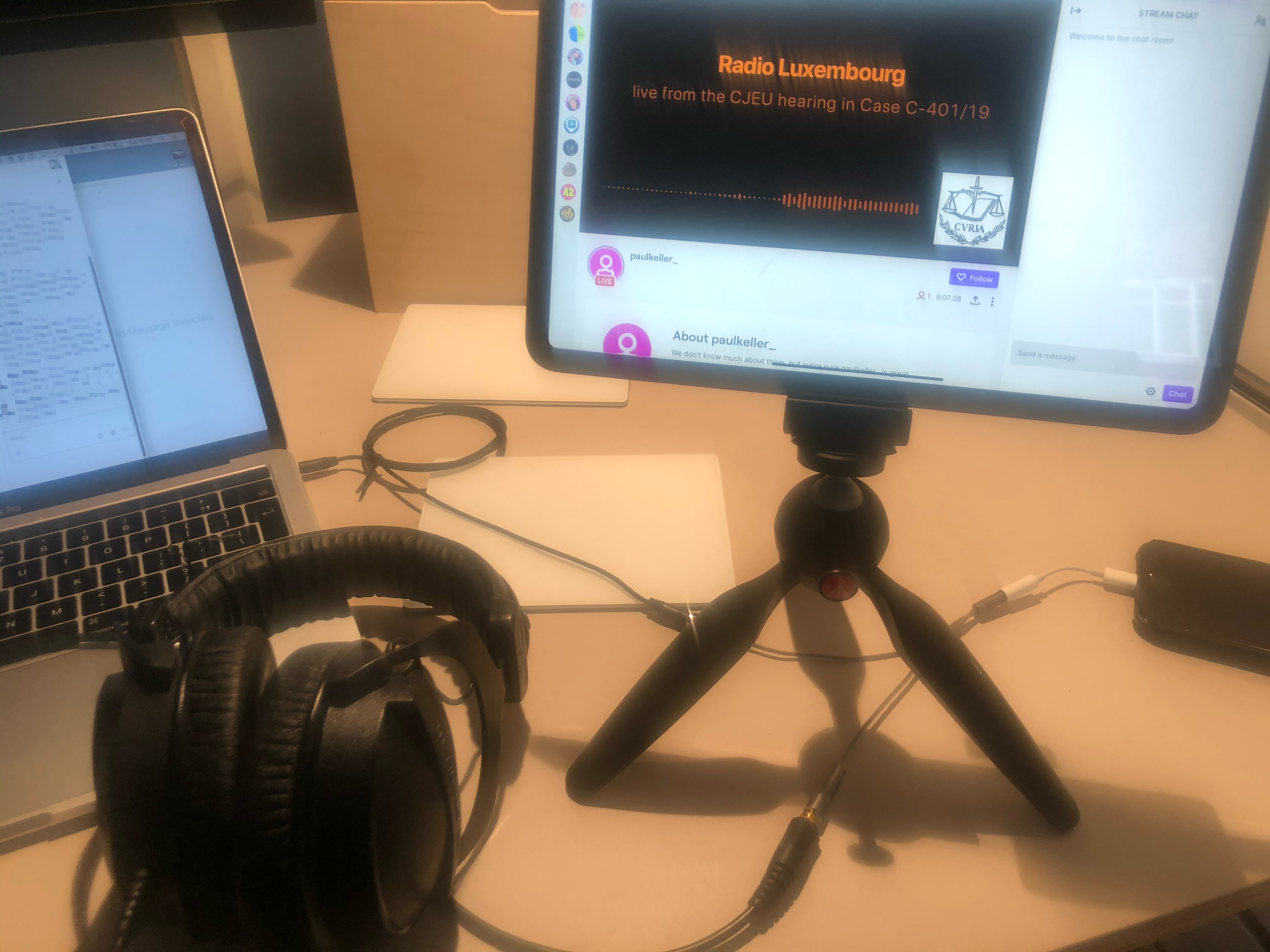
Before driving down to Luxembourg i had considered to try to live stream the hearing. I had set up a twitch channel ("Radio Luxembourg") and brought some audio equipment that would have allowed me to capture and stream the audio of the hearing from the court’s audio system. Once arrived at the court and set up in the press centre, I quickly abandoned these plans after being reminded that the Court really does not want to have its workings communicated to the public. Usually I am not someone who quickly complies with senseless rules — but even I did not want to mess with Europe’s highest legal authority.

Sign on the wall of the press room of the CJEU

So I settled behind my laptop and engaged in a furious sprint of note taking (not necessarily an easy task given the multilingual nature of proceedings at the CJEU) and published the only(!) publicly available report of the hearing.

All of this is to say that I am extremely happy to hear that yesterday the Court has finally decided to embrace modern technology and will start streaming Grand Chamber hearings and judgements as of next week (pdf).

Coincidentally this means that the first judgement that will be live streamed by the court will be the judgement in Case C-401/19, the case that made me drive through the night to cover back in November 2020. Stock up on the 🍿 and tune in for episode one of season one of CJEU-TV on Tuesday 26 April at 0930h CET (and then join us for our COMMUNIA Salon to discuss the implications of the judgement on Thursday 28 April at 1530h CET).

Apart from this - happy? - coincidence the decision of the Court to finally stream its public proceedings is extremely welcome in general. Justice and democracy do not flourish in darkness and scenarios in which public access to the deliberations on fundamental rights is dependent on some random activist being able to drive across borders are not conducive to trust in our democratic institutions.

Do not travel abroad unless necessary — signboard alongside the A2 highway at the Dutch - Belgian border

Back in November 2020 after the hearing, i expressed my frustration about the senseless aversion to stream the hearing to the court’s extremely friendly and helpful press officer, who turned out to be just as frustrated with this decision as i was. He also hinted that there were discussion ongoing among the judges and that he and his colleagues were pushing for more openness. As it is well known, the wheels of justice turn slowly but now — with a number of additional waves of covid behind us and the acute urgency gone for now1 — the court has finally realised it does indeed make sense “to facilitate the public’s access to its judicial activity” by streaming its proceedings.

Now let’s hope that the CJEU’s streaming infrastructure will be up to the task to provide access to Tuesday’s judgement, which is highly anticipated by a lot of people.


  1. Even if you can now follow proceedings online, if you ever have the possibility you should still go and attend a hearing of the court in person at least once. ↩︎

Punkt. Aus

This year I got myself a Punkt. MP02 mobile phone. I had been eying the Punkt. for a while as a secondary phone that I could use during periods when when I wanted to avoid the distraction potential that comes with my smartphone — vacations or an evening out at a restaurant or at friends for example. Sometime in 2021 the Punkt. — which is essentially a phone that can do calls, SMS and function as a 4G hotspot — gained the ability to send and receive messages over Signal — which given that I do my messaging over Signal and iMessage — made switching for periods of time feel like a viable option (unlike iMessage which will fall-back to SMS, Signal messages just stay undelivered if the receiving client is not active).

I got the Punkt. on xmas eve and while it is indeed a very nice piece of hardware, that feels nice in the hand I was disappointed almost immediately. Setting up Signal (via an app that is called Pigeon) was extremely cumbersome (mainly because is includes a step where you need to solve an image captcha, that is extremely buggy on the phone’s small screen) and once I had managed to set up Pigeon, the app kept crashing immediately after opening it. The other problem was that by signing into Signal on the Punkt. I was immediately signed out of Signal on my iPhone (which was kind of expected) but also on my laptop (i am a heavy signal user on the laptop and had not considered this).

At the time Punkt. had already announced that a new version of Pigeon would be released on the 27th of December so I boxed up the MP02, went back to the iPhone and waited a few days.

After installing the Pigeon update a few days later, I did manage to get Signal up and running on the phone (while suffering thought the same buggy captcha process again) and could receive and send (with all the drawback that come with suddenly being thrown back to T9 text input) Signal messages on the phone. A few days later we went on vacation to a remote corner of Denmark and I was determined to rely on the Punkt. for that week.

Punkt. MP02 + Laserwriter II on the table of our vacation house

During the week in Denmark week I tried to stay away from the internets and anything work related as much as possible and the Punkt. certainly helped with that. Still other limitations of not using an iPhone became painfully clear almost immediately. While I had bought the Punkt. primarily to avoid distractions and to be less reachable there are in fact lots of functions integrated into modern smartphones that are simply helpful without being distracting.

I had expected that I would miss things like recording my runs on Strava and listening to podcasts while running (both of which work perfectly fine on my non-internet connected iPhone which I took along for my runs) but some other limitations where less expected: the fact that the Punkt. does not support contactless payment (a la Apple Pay) means that I needed to carry a wallet with me for the first time in two or so years. But it was the fact that the Punkt. does have no ability to display an EU Digital COVID Certificate is what ultimately made me swap my SIM-card back into the iPhone and abandon the whole experiment. There was no printer in our vacation house in the remote corner of Denmark but more fundamentally — this being the 21st century — I am simply not willing to go back to carry papers around with me as a trade-off for having less distraction in my life.

Tomorrow UPS guy will come and pick up the phone under Punkt.’s Hassle-free 30 days returns policy and I will be a bit sad that this experiment did not work out. The MP02 is a really nice piece of hardware and I would be happy1 to give it another try if they manage to support Signal in a way that you can run it on multiple devices and switching SIM-cards does not involve silly captcha acrobatics anymore (assuming that by then COVID-19 will be endemic and there is no need to regularly show COVID certificates at random moments of the day).


  1. There is one thing that I am really disappointed with: One of the promotional shots of the MP02 on the Punkt. website shows the phone with a map based interface on the screen which I really liked. Turns out that this is simply a mock-up and that this particular interface does not exist for real. ↩︎

Faux songs and old concepts

24 Jul 2021 | 373 words | music artificial intelligence copyright

Billboard magazine has a fascinating piece on the rise of the use of deepfake vocals to create what the piece terms “faux songs”: ‘It’s Fan Fiction For Music’: Why Deepfake Vocals of Music Legends Are on the Rise.

The piece showcases the recent rise of deepfake vocals (vocals produced by computers that closely resemble the voices of well known artists) in new songs that are generally produced without involvement of the artists who’s voices are reproduced1. It is a super interesting introduction into a world of music production full of delightfull wired-ness. I particularly like this track featuring a recreation of Travis Scott’s voice, which combines glitchy aesthetics with what the agency producing the song “considered to be cohesive lyrics”:

Sadly the main thesis of the piece (“Faux songs created from the original voices of star artists are becoming more popular (and more convincing), leading to murky questions of morality and legality”) does not do this phenomenon much justice. The idea that this type artistic production enabled by digital manipulation techniques can somehow be understood though concepts like “faux” vs “orignial” strikes me as outright silly. Quite obviously the “faux” works are just as orignal as any of the “originals” that the voices are derived from.

Even more problematic are continuing attempts to fit this type of creativity into existing concepts like authorship and copyright. The realities of creative production today are so far removed from the realities in the late 19th century (when modern ideas about copyright and authorship were codified) that it really does not make much sense to try to analyse them throught the lens of these concepts.

We urgently need new concepts that do a better job at recognising artistic innovation while at the same time ensuring that the value created in the process is fairly distributed.


  1. Fortunately the author does fall into the trap pretending that these songs have been produced by “artificial intelligence”. While he mentions the term once, the article makes it clear that these songs have been produced by people who are using machine learning models to generate the deepfake voices. In the examples discussed in the piece the actual lyrics, beats and compositions (ie the copyrighted works) are all written by individuals or teams. ↩︎

This blog has moved (again)

10 Jul 2021 | 180 words | internet

A quick note that i have moved this blog back to my own server. After 2 years or so as a ghost1 instance hosted somewhere in the clouds provided by Digital Ocean it is back on my own server (provisioned by tuxic.nl). I have rebuild the entire site as a set of static pages generated with Hugo.

Unfortunately this move means that the new version replaces the very first (wordpress based) iteration of this blog which was also hosted here but had a different url structure and now external links to the first version are broken. I have attempted to create redirects for the old urls but have failed to do so (something to do with escaping “?“s in the old urls), which gives me considerable grief in having just read Jonathan Zittrain’s excellent long read on the rotting Internet in the Atlantic.


  1. I still very much like what ghost is doing (and would probably use it again for other projects), but maintaining my own install in the cloud required way too much maintenance for a small personal side project. ↩︎

Europe Asia Express

04 Oct 2020 | 210 words | europe railways travel infrastructure maps

Lately there has been a lot of talk about reviving the Trans Europe Express (TEE) that had its heyday well before i was even born. If that means more investment into high-speed trans-european rail infrastructure it has my full support (even though it will be next to impossible to match the design sensitivity that came along with the TEE).

Speaking about railway nostalgia, I came across this illustration on flickr today, which illustrates the networks serverd by the TEE predecessor Simplon Orinet Express and its middle eastern equivalent the Taurus Express in the late 1930s:

Taurus Express and Simplon Orient Express via Bruce Sterling's flickr

If there is talk about reviving old railway networks then we should probably skip the TEE and go right here. If revieved, this network would cover more than enough of the world for me to never set foot into an airplane again and spend the rest of my life exploring these parts (as of writing i have visited or lived in 9/11 of the stops on the European side of this network and 7/13 on the Afrian/Asian side).

And since we are discussing reviving express trains here, i am also very much looking forward to the Chungking Express sequel that is apparently in the works.

Destroying e-bikes for profit

28 May 2020 | 243 words | cycling capitalism

early last year i wrote about the joy of using JUMP e-bikes during a short stay in San Francisco1. Turns out that less than one and half years after being introduced, these bikes, while still being perfectly good and much needed, are getting retired and destroyed by the truckload.

This seems to be the outcome of an unfortunate but probably inevitable collisions of the logics of startup consolidation and the dysfunctional way how the US legal system structures liability. As many others have pointed out before me, destroying perfectly good bikes instead of giving them away to people for whom having access to a bike could make a world of difference, is the logical conclsuions of the sociopathic business model of so called “sharing platforms”.


  1. I have sometimes wondered if that post was not too much in terms of expressing admiration for an UBER owned service, but i really did enjoy riding on those bikes. So i am somewhat relieved to find out that i am not the only one who admired these particular bikes. As Kurt from the bikesharemusuem observes: “Put simply, the JUMP e-bike is a wonderfully clean and well thought-out design, straight out of The Jetsons; just substitute the wheels for rockets. This made the experience of riding all the more exciting, in the same way some become giddy at the thought of driving a Lamborghini at 10 mph: It’s not that you’re doing anything extreme, it just feels special.” ↩︎

On urban cycling and electricity

20 Nov 2019 | 141 words | cycling urbanism

I have always considered myself to be a fairly accomplished urban cyclist. Much of this confidence stems from having worked as a bike messenger between 1993 and 2004, mainly riding fixed with no brakes. Over the years, the rules of the urban cycling game have not changed much even though cycling became massively more popular during at the same time.

However, over the last few months the game is changing by the emergence of a new class of participant, the electrical motor assisted cyclist. As a result i am finding myself learning again, this time trying to master the art of drafting-off e-assisted cyclists navigating though urban traffic1, which is a fun game to play… (these days on bikes with imperfect brakes which significantly increases the difficulty)


  1. These days i am riding bike with brakes, although this does not necessarily help. ↩︎

meanwhile... is the personal weblog of Paul Keller. I am currently policy director at Open Future and President of the COMMUNIA Association for the Public Domain. This weblog is largely inactive but contains an archive of posts (mixing both work and personal) going back to 2005.

I also maintain a collection of cards from African mediums (which is the reason for the domain name), a collection of photos on flickr and a website collecting my professional writings and appearances.

Other things that i have made online: